Post-graduate studies is ‘adult education’ for some of us and it is not easy, especially when combined with a regular job and other ‘adult’ responsibilities. My MSc and PhD years were probably the most stressful part of my existence. The good news is that despite overwhelming challenges, I finished the program on schedule and first from my class. I get a lot of inquiries how to cope with post graduate programs , so I want to share one my potent strategies 😌, having a personal workplan/calendar.
Preparing a personal calendar is an essential component of success in postgraduate research. A well-planned schedule can help you stay on track, meet deadlines, and make progress towards your research goals. In this post, I will outline the steps for creating a personal calendar for your postgraduate research and share mine too.

Step 1: Define your research goals and objectives
The first step in creating a personal calendar is to define your research goals and objectives. This will help you determine what tasks need to be completed and when they need to be completed. Your research goals and objectives should be specific, measurable, achievable, relevant, and time-bound (SMART). When do you want to graduate? What will be the consequence if you don’t finish on schedule? Keep this in mind so you don’t pay for an extra year.
Step 2: Identify key tasks and deadlines
After defining your research goals and objectives, the next step is to identify the key tasks and deadlines that need to be completed to achieve those goals. This could include tasks such as conducting literature reviews, collecting data, analyzing data, and writing chapters of your thesis. You can only control your input, not the supervisor’s. So plan to put in the work. The HOW to complete a task is so important, write it down.
Step 3: Determine how long each task will take
Once you have identified the key tasks, the next step is to determine how long each task will take to complete. This will help you estimate how much time you need to allocate to each task and when you need to start working on each task to meet the deadlines. Ask questions from those who have finished, challenge yourself. You have a brain that works too.
Step 4: Create a timeline
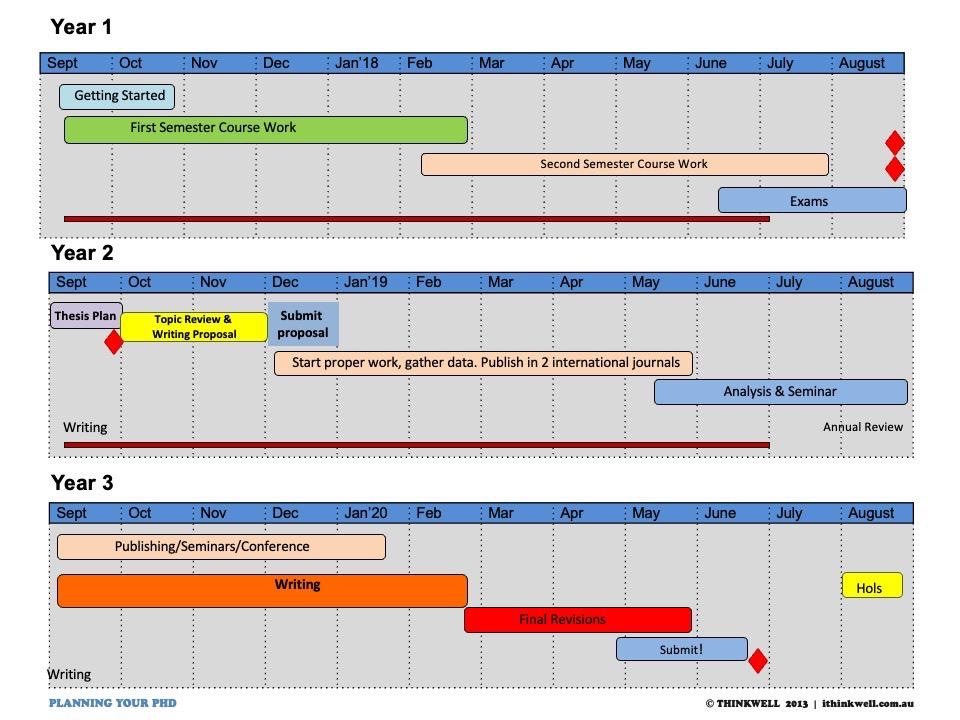
With the tasks and deadlines identified, the next step is to create a timeline. This can be done using a calendar or a spreadsheet. The timeline should include all the key tasks, deadlines, and estimated timeframes for completing each task. I understand work gets you exhausted but you find time. For instance, If you’re a morning person you could dedicate 30 minutes everyday to work on your research/assignments, then weekends. Other social pleasures can wait temporality, right?! See my 3year PhD plan below 👇🏼
Step 5: Prioritize tasks
As you create your timeline, it’s important to prioritize tasks. This means identifying the tasks that are most important and need to be completed first. Prioritizing tasks will help you stay focused and ensure that you are making progress towards your research goals. Find what works for you and get support from colleagues or alumni. You need not do this alone.
Step 6: Review and adjust your calendar regularly
Finally, it’s important to review and adjust your calendar regularly. As you work on your research, you may encounter unexpected challenges or delays that require you to adjust your timeline. Regularly reviewing and adjusting your calendar will help you stay on track and ensure that you are making progress towards your research goals. My calendar had some lag times and I put it in there because I knew I would lose steam sometimes. The important this is that you make steady progress ( within reasonable timeline).
In conclusion, creating a personal calendar is an important step towards success in postgraduate research. By defining your research goals and objectives, identifying key tasks and deadlines, determining how long each task will take, creating a timeline, prioritizing tasks, and regularly reviewing and adjusting your calendar, you can stay on track and achieve your research goals.
‘Adulting’ comes with responsibilities including continuous personal development which takes us back to school sometimes. Effective Planning and time management will help you through this. Beryl Consults provides virtual assistance in this regard. However, it is important to note that you made a good decision to take that new program and you’re going to ace it big time. I’m rooting for you 😇😉😎.
Any questions? 🙂
 BERYL CONSULTS